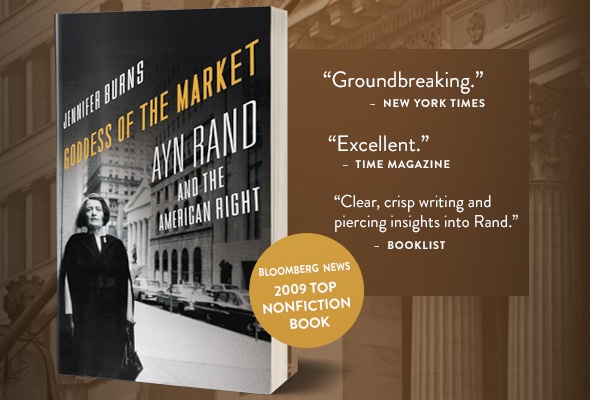
Goddess of the Market: Ayn Rand and the American Right
![]() |
|
"This is a wonderful book: beautifully written, completely balanced, extensively researched… It is hard to imagine that it can be surpassed as a history of Rand, her ideas, and life."
- Mises Economics Blog
Worshipped by her fans, denounced by her enemies, and forever shadowed by controversy and scandal, the novelist and philosopher Ayn Rand was a powerful thinker whose views on government and markets shaped the conservative movement from its earliest days. Drawing on unprecedented access to Rand’s private papers and the original, unedited versions of Rand’s journals, Jennifer Burns offers a groundbreaking reassessment of this key cultural figure, examining her life, her ideas, and her impact on conservative political thought.
Watch Jennifer Burns on the Daily Show with Jon Stewart
| The Daily Show With Jon Stewart | Mon - Thurs 11p / 10c | |||
| Jennifer Burns | ||||
|
||||
| Was Ayn Rand Randian? |
| Thursday, 15 September 2011 06:23 | |
|
This article is reprinted from The Washington Post, September 4, 2011. Ayn Rand burst onto America's literary scene in 1943 with her novel "The Fountainhead" and its unforgettable hero, Howard Roark, a paragon of manly independence and rugged individualism. Cast out of architecture school for his subversive designs, Roark merely laughs. When his nemesis, Ellsworth Toohey, a critic who has ruined his career, taunts him by asking, "Why don't you tell me what you think of me?" Roark replies serenely, "But I don't think of you." The Russian-born Rand insisted that her novel was a blueprint for moral living. "The Fountainhead" was but the first step in her larger presentation of objectivism, the philosophy she would create. Although Rand would eventually expand objectivism into a system encompassing everything from politics to sex to art, at its base lay the celebration of the independent, rational individual epitomized by Roark. For Roark, the views of critics — indeed, of anyone other than himself — were meaningless. "To a creator, all relations with men are secondary," he counseled, arguing that "the degree of a man's independence, initiative and personal love for his work determines his talent as a worker and his worth as a man. Independence is the only gauge of human virtue and value. . . . There is no standard of personal dignity except independence." What mattered to the creator was the joy of creation, not the accolades or status sought by contemptible "second-handers." Rand claimed to follow Roark's lead. In a letter to fans, she declared starkly, "My own character is in the pages of The Fountainhead." She added: "I have no hobbies. I have few friends. I do not like to ‘go out.' I am unbearable — to myself and to others — when I stay too long away from my work." Fiercely committed to laissez-faire capitalism and limited government, Rand was an equally fierce atheist and despised the religious beliefs of most conservatives. America needed a secular philosophy of individualism, rationality and small government, she declared. She began teaching this philosophy to a small group of devoted acolytes, including a young Alan Greenspan. In 1957, she presented objectivism to the world in "Atlas Shrugged," her 1,000-plus-page opus featuring another Roark-like protagonist, John Galt. Rand expected opposition, but she also was confident that her work would be widely celebrated. Instead, she was shattered by the negative reviews. Although it hit the bestseller lists immediately, critics savaged "Atlas Shrugged." Liberals hated her politics, conservatives her atheism, and almost everyone said the book was poorly written. Rand tried, but she couldn't live up to Roark's stoic disregard for the opinions of others. She retreated to the privacy of her Manhattan apartment, weeping daily and losing herself in endless games of solitaire. The philosopher of rationalism found herself swamped by emotions she could neither understand nor control. In desperation, she turned to Nathaniel Branden, the most loyal of her followers. Years before, flush with inspiration, she had taken Branden as a lover, disregarding both their marriages and the fact that she was 25 years his senior. Now Branden became her therapist, helping Rand pick through the wreckage of her ideals. Howard Roark wouldn't feel like this, she moaned to him, nor would John Galt. Despite believing in Rand's philosophy of independence, Branden understood that his mentor needed the adulation of others. He created the Nathaniel Branden Institute, an organization that taught courses on Rand's philosophy. The institute grew alongside a reinvigorated libertarian movement that made Rand an icon of the right. Revived by the stream of young people interested in her ideas, Rand continued to preach individualism, even while insisting that her students accept objectivism without question. She told none of them about the dark days after "Atlas Shrugged" or about her secret affair with Branden. Discovering individualism's limits was something each objectivist would have to do alone. |
Watch Professor Burns on The Daily Show with Jon Stewart Oct. 15th!
- Was Ayn Rand Randian?
- Maker Faire: Where Libertarian Dreams Come True
- The Right Since Obama: The Rise of Market Fundamentalism
- My Appearance on the O'Reilly Factor
- In the Rand Archive, Part 6: On the Brandens, Continued
- Money in Politics: A Case Study from 1948
- 2009: The Year of Rand
- A question about Howard Zinn
- Bookplates: Personalize your copy of Goddess of the Market!
- In the Rand Archive, Part 5: On the Brandens
- In the Rand Archive, Part 4: What Will Happen Next?
- Top Three Questions about my interview with Jon Stewart on The Daily Show
- Book Tour video
- In the Rand Archives, Part 3: Publishing
- In the Rand Archives, Part 2: The edited letters and diaries
- In the Rand Archives, Part 1: Gaining Access
- Libertarian Squishiness: Or Why the Right is Not Conservative
- Thoughts on the literary present as it relates to Ayn Rand
- Ayn Rand heart Farrah Fawcett
- Is Obama the next FDR?
- Classic Books about Reconstruction

Personalize your copy -- or give a special gift -- with a free signed book plate! Click here for info.